
After my time spent underground in New Brunswick early in 2023 (see cc 93:), I felt like there was still so much more to see. A flight sale came up so I jumped on the opportunity and flew back from BC to the East Coast.
Christopher’s Chasm
On my final flight of four legs to New Brunswick, I ran into my buddy Aaron, who was keen to get out on an adventure. We made plans to survey Christopher’s Chasm near the Saint John airport.
It had been many years since I was last there, so the route was a bit hazy. Our first attempt brought us to a fine climbing route, but was not the right place. Recalibrating we found the old road up to the open hilltop. From the top, we had a 360 degree view of Sussex, St Martins, Saint John, and the coast of Nova Scotia along the eastern margin of the Bay of Fundy. From here, there was a short flagged to trail to the entrance.

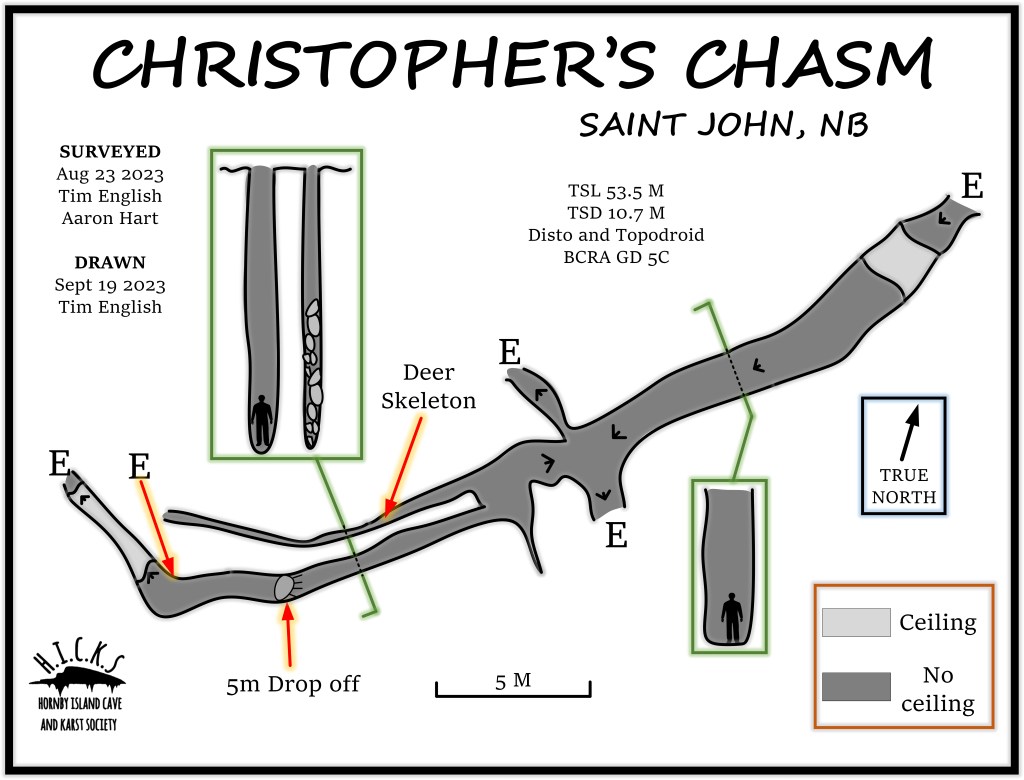
We surveyed into this very interesting crevasse from the lower end. It is basically a giant fracture which gradually splits into two. One of them was impossible to enter, did have a suspended deer skeleton, evidence of an unsuccessful past accidental exploration attempt. The other one carried on for another 25m or so. Most of the chasm had no roof, but did have a section of complete darkness. The deepest section of the crevasse was about -10m. The total survey length ended up being 53.5m.
Saint John Exploration
I remembered searching under power lines between Rockwood Park and Milledgeville when I was a teenager, finding several resurgences and lots of exposed limestone. Unfortunately, Saint John, as with everywhere in the country, has acquired a serious homelessness problem. The area I remembered was now tent cities and garbage-filled creeks with tarps and shopping carts strewn everywhere. The adjoining neighborhood was something you’d see in a movie, with children playing in streets and around burning piles of garbage on the side of the road.
I headed to the grocery store for a snack, and noticed it was actually within a limestone quarry. With a quick search I found a resurgence coming out of a crack and flowing into a public drain. Poking some more, I was eventually approached by the quarry security who thought I was there to set up camp. Across the road was an office for the quarry, so I went in and talked to the workers, some of whom had been there 30 years. None had heard about caves in the area, but were happy to give me permission to look around. After finding three caves in the first half hour, I was told that this was enough time spent and I should move along.
Later, I met up with Donald McAlpine of the St John Museum to show him the entrance of Lion’s Den Cave, It was nice to have a good chat about caves.
Tabers Cave Dig
Another spot I remembered from my teen years was an area near Kitts Cave which used to have a roadside sign that said Tabers Cave. I never found a cave at the spot, but there are lots of sinking streams and large sinkholes – there’s definitely something underneath this area. I figured a good place to dig would be where the largest stream goes under a bluff in a small canyon, where I dug for about 15 minutes. Unfortunately, this only seemed to plug the cave and flood the gully. I looked at another nearby sinkhole and found that this could be a potential cave. After 25 minutes of digging, I had a human-sized hole before heavy rains started. Something for a later date.
Havelock
When I was a kid I used to read about the suspected longest cave in the province Archie’s Hole, Legend has it, a pig fell into the entrance of the cave only to emerge a few miles away in someone’s basement. Fanciful, but still very intriguing. A limestone quarry was built in the area and, seeing the cave as a hazard, filled the entrance. Years later, a few cavers convinced them to re-open it temporarily The cavers went in and found that it did not, in fact, go any substantial distance.
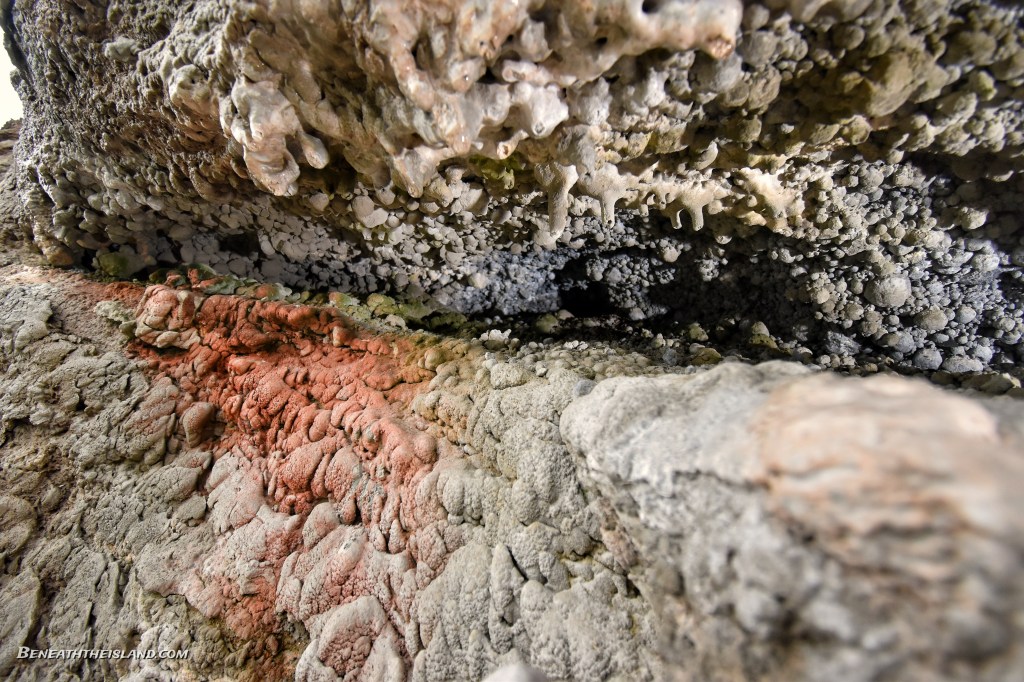
I decided to see if anything has changed over the years. Driving by the first thing I noticed was a cave entrance on a hill above where Archie’s Hole is supposed to be. Inside, I found the most interesting limestone I have ever seen. Conglomerate of small perfectly round limestone rocks held together with beautiful, mostly red calcite formations.

Unfortunately, the cave itself was just a few metres long. I eventually found the Archie’s entrance, which was still filled in and had only recently had a rock crushing machine removed from atop of the entrance. I also found a few spots where water had seeped through layers of concrete and rebar, directly at the coordinates I was given. It is a shame, but I believe this is the end of the story of Archie’s Hole.

Underground Lake Day
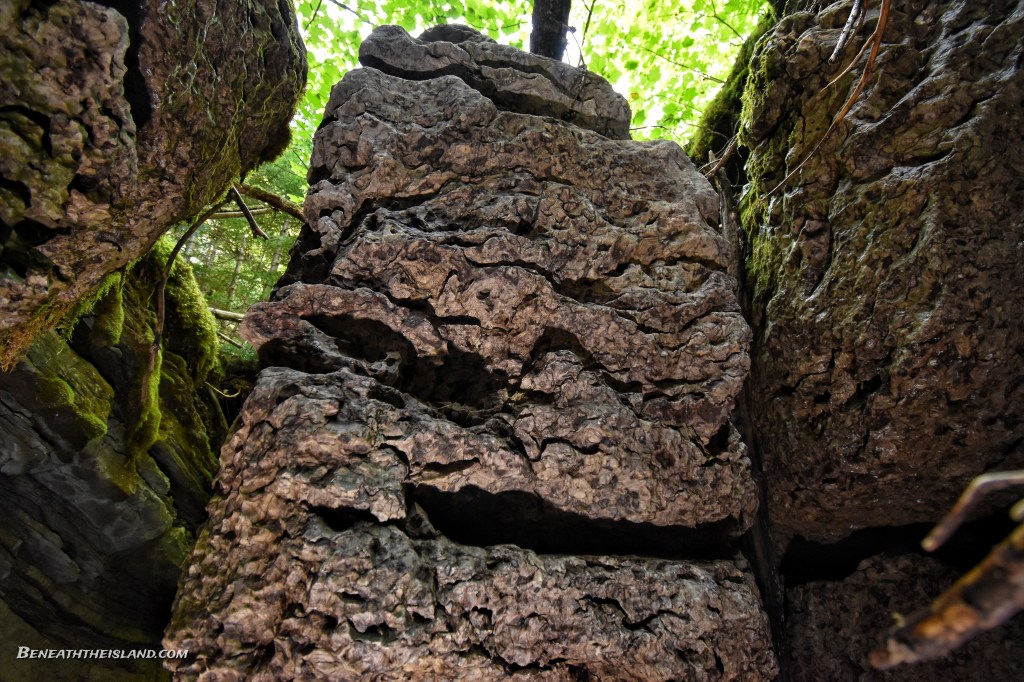
Following coordinates from the NB report by Arsenault et al., I found the entrance of Underground Lake Cave with no difficulty. This cave is truly beautiful and was my first gypsum cave. The passage walls look like flaked burnt crumbly limestone I see after slash piles are burned on carbonate karst. It seemed to resemble compressed oyster shells with paper mâché holding it together. As the name suggests, the cave is basically big underground lake with a scree slope angled into it for access, so there is really no good place to stand. It turns out there was a dive no and survey completed by Sawatsky and Moseley and reported in 1985 (CC 18(2):53), including a great exploration account. A more detailed history and description was presented by Eric Hendrickson (CC 56:34) . Later, this was the test site for an underwater remotely-operated vehicle developed as a student engineering project at Dalhousie University (CC 92:8).

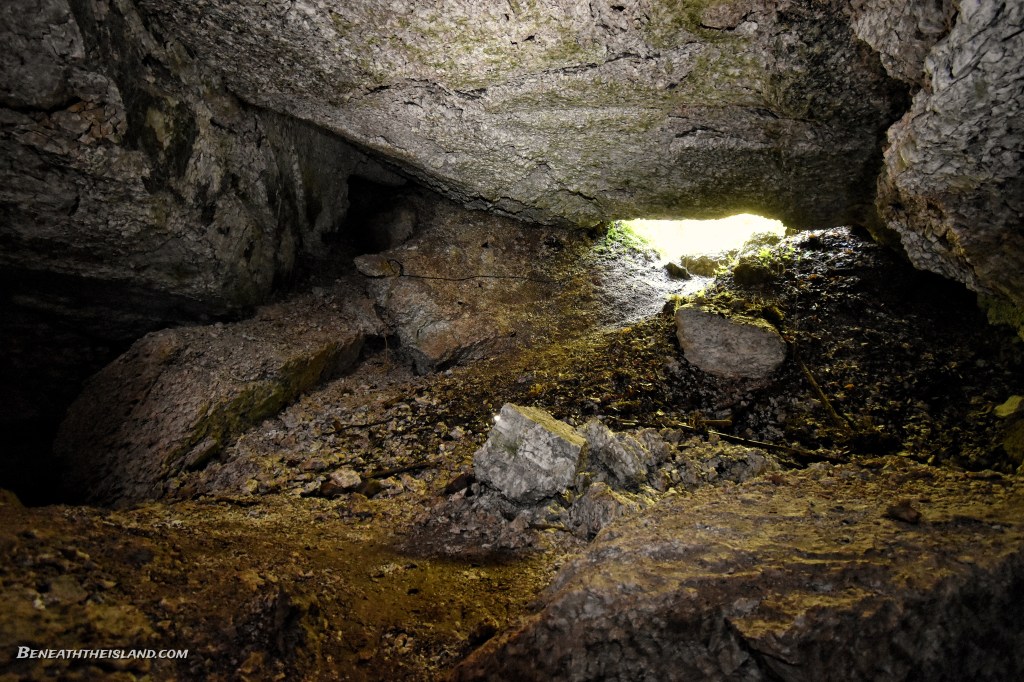
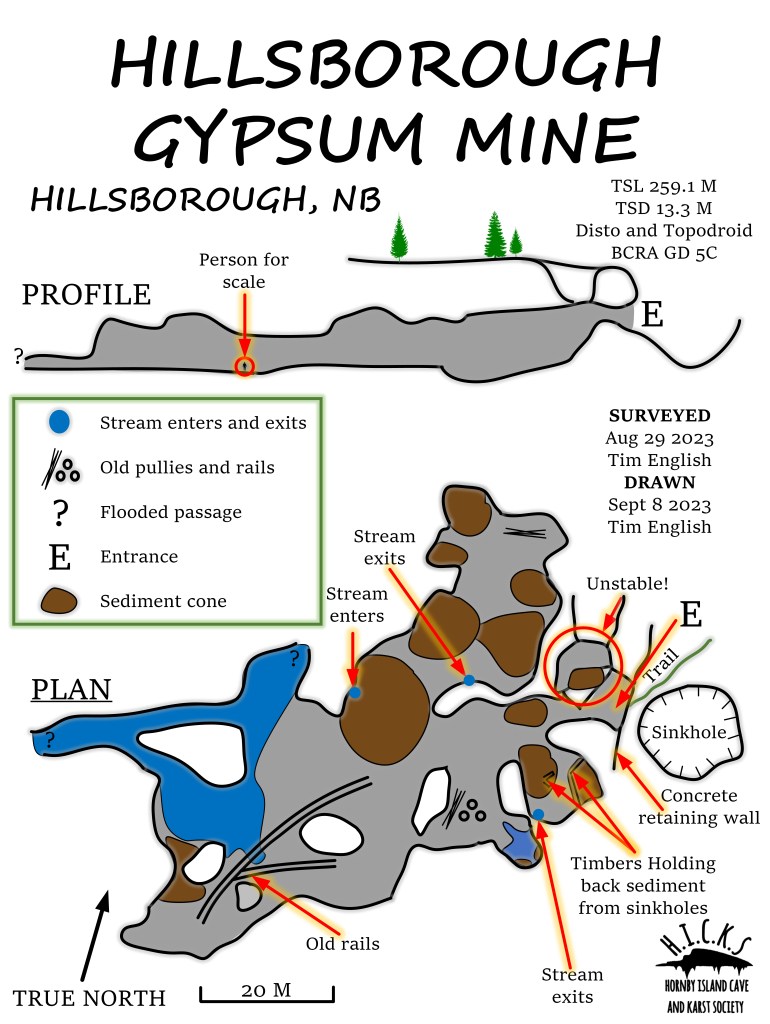
After a few pictures, I headed to the nearby Hillsborough Gypsum Mine. I could find no survey, history or trip reports or anything about this easily-accessible mine. The entrance looked like a cave at first glance. It is a really interesting gypsum arch leading into another arched entrance and down into a very large room. It was pretty creepy being alone here, as random drips from the ceiling sounded like people talking. I’m guessing this thing is a couple of hundred metres long with a few mining remnants like tracks and winches left behind.
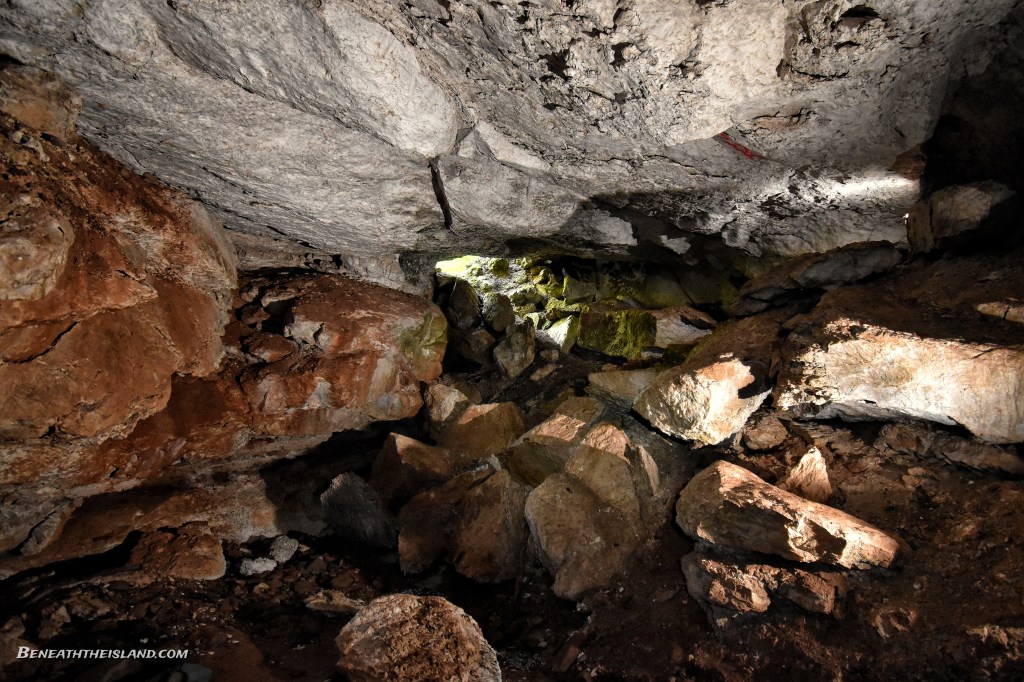
With quite a bit of daylight left I went to White Rock Park to find the entrance to White Caves, the longest cave in the province. I followed it to where I didn’t feel like going further alone, gypsum caves being very crumbly, it didn’t seem prudent to push any crawlways. I went overland to the north entrance, which apparently connected before the passage between collapsed. This entrance was very similar to the south entrance. Above ground the area is full of sinkholes and disappearing streams, and I feel there’s a lot more here than just this one cave. White Cave North is a total of 515m and the south one is 105m long.
Gypsum Mine Survey

Since there seemed to be no survey of the gypsum mine, I thought it would be a good use of the day to map and draw one. I thought it would be fun, as it’s an absolutely massive room and I felt safe enough to do on my own. The mine itself has a low entrance into a large room with a few very large offshoots. When they were mining, they cut massive curved arches with several columns between to support the large ceiling. The offshoots go quite a ways and there are a few flooded passages which I didn’t get to survey. Total survey length was 259m with an average ceiling height of 10m. It would be really nice to find the history of this mine, known localy as The Hillsborough Gypsum Mine.
The day was still young, so I went to find another cave in the Arsenault et al. report, called Lost Brook Cave, This took some bushwhacking, as the trail was completely gone and grown-over. It doesn’t look like it gets too many visitors, which is probably a really good thing. This cave seems to be more of a karst window than a cave, but there are definitely sections that are dark. There is an active stream and many different types of limestone meeting at this point, which likely contributed to it’s formation.
After Lost Brook Cave, I made my way over to King’s Thorn Cave, which was pretty deep in the bush. This cave is tiny, with a squeeze sinkhole entrance I did not attempt alone. There seems to be no survey for this cave, so it will be on my list for a coming trip.

Havelock Again
Another site in the Havelock area I had read about in the past was Catherines Cave. This cave went under the road and had a few big sinkholes above it. A survey was drawn, making it one of the longest caves in the province at 264m.

It didn’t take long to find the entrance which unfortunately had a newly-installed welded rebar gate blocking the passage. The first thing I noticed was a muddy stream exiting the cave. After aligning the map to the surface area, I realized that this cave went directly underneath a massive limestone quarry. In talking with the workers, I found that the boss had gated the cave for safety reasons and that their entire quarry is basically one big chunk of swiss cheese with massive voids everywhere being exposed daily. Sadly, I witnessed the removal of a portion of cave while I was there.
Kitts Cave and Tabers Dig Again
With the morning free, I returned to the dig at Taber’s Cave before caving at Kitt’s Cave with my sister, niece and nephews. After about a half an hour of digging, I had tripled the size of the opening. This dig seems to be going straight down not to the side, and seems a completely separate stream from the one that comes in on the other side. I spent the next few hours hoofing around downhill and found a substantial resurgence that must drain both streamways. In my investigation, I found several more sinkholes which had, for years, been used as a garbage dump by the farmer who owns the land.
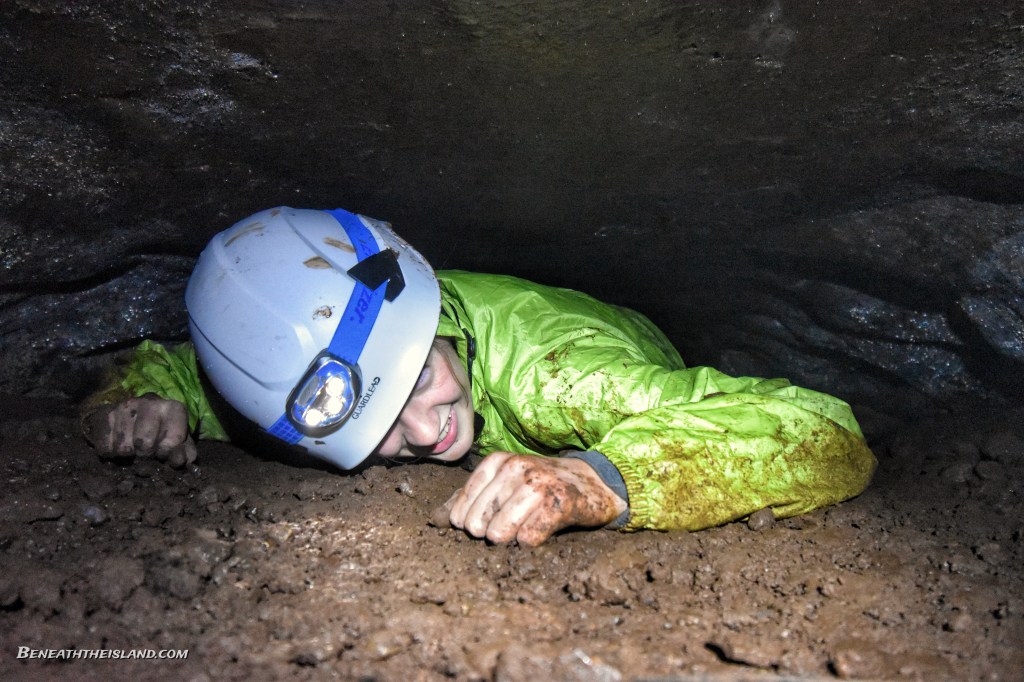
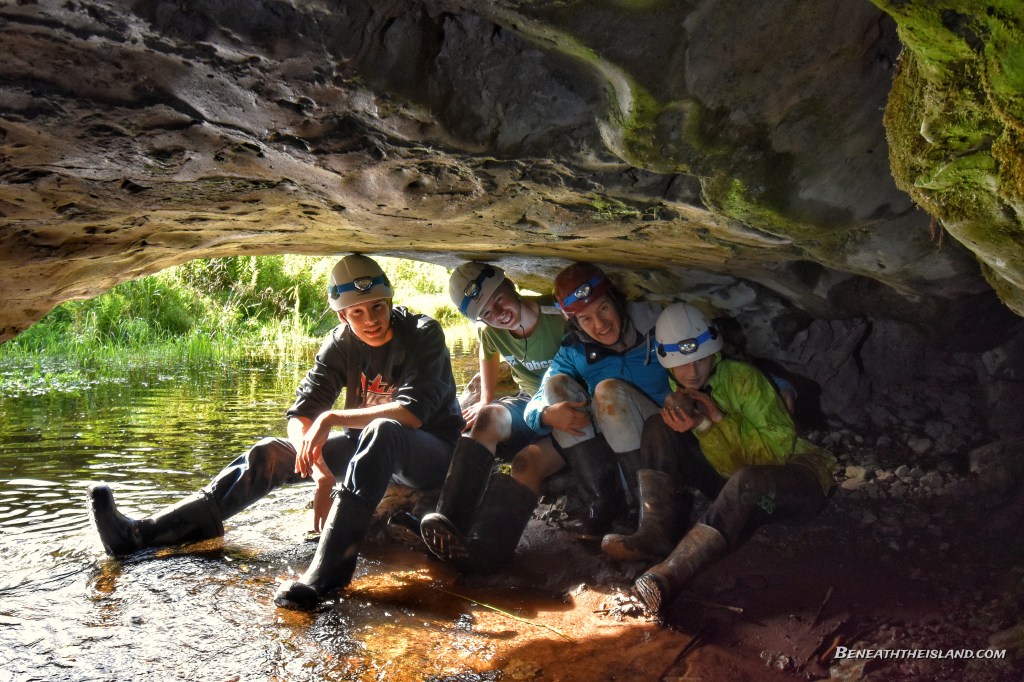
We later went into Kitt’s Cave with spare clothes and cave suits enough to be able to make it to the very end. Lots of fresh beaver sign from the resident beaver, who was fortunately not there during our exploration. The kids had a great time and pushed further than I ever had in a few very small passageways.
Outro
Another amazing adventure in the caves of New Brunswick, leaving me wanting more. It would be nice to see more interest in the area and hopefully this article inspires some east coasters to get into some project caving. Looks like I may have a return trip in late May 2024, and if anyone wants to reach out, I’d welcome others get involved involved in the exploration and surveying.
Written by Tim English
Intro and edited by Pat Shaw
Previously published in #94 (Feb 2024) of the The Canadian Caver Magazine
 BENEATH THE ISLAND
Leave a comment